A bedroom that needs a vanity but genuinely has no obvious place for one can still feel organized and useful. The setups below show you how to turn small corners, dresser tops, and narrow ledges into working grooming spots without buying bulky furniture or rearranging everything you own.
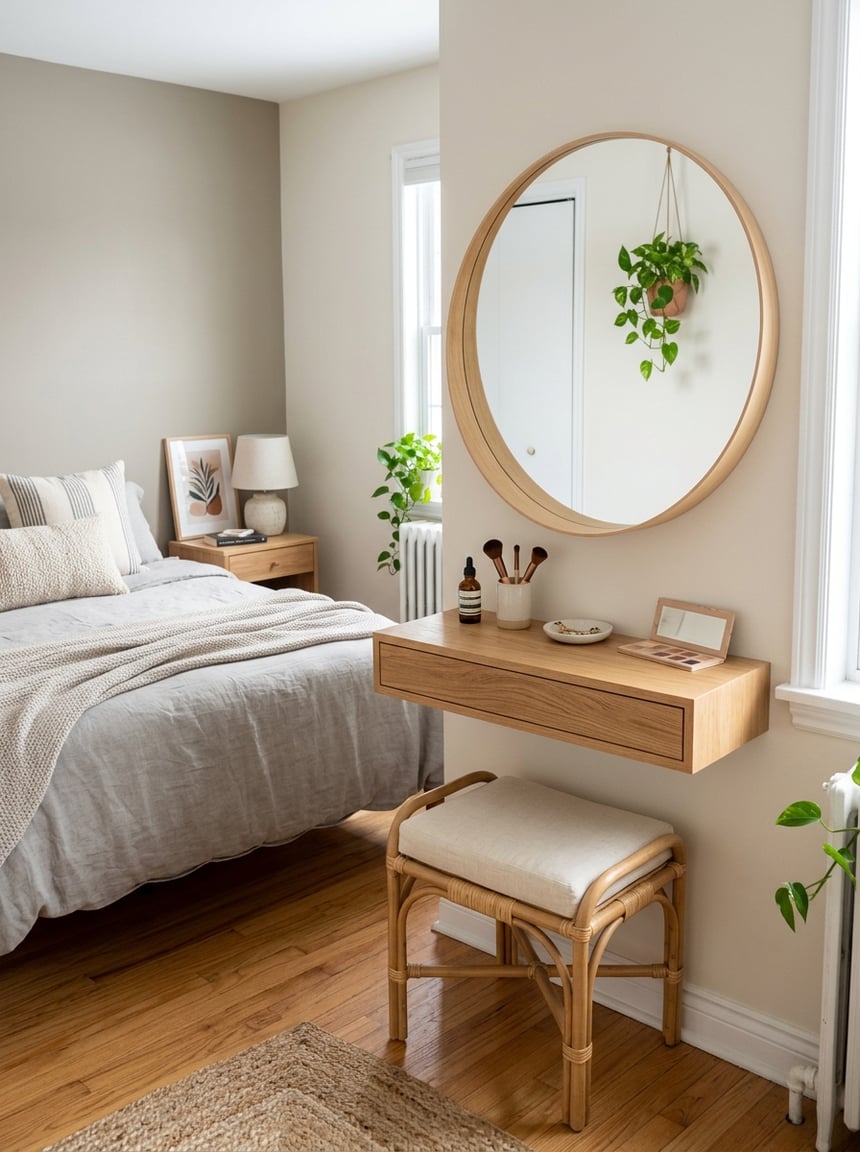
Each idea here uses what's already in the room differently: walls, doors, corners, and surfaces that are already doing one job can usually do two. You'll find low-cost ways to add light, hide clutter, and carve out a spot that feels deliberate without making your room feel smaller.
1) A Floating Shelf and LED Mirror on the Wall
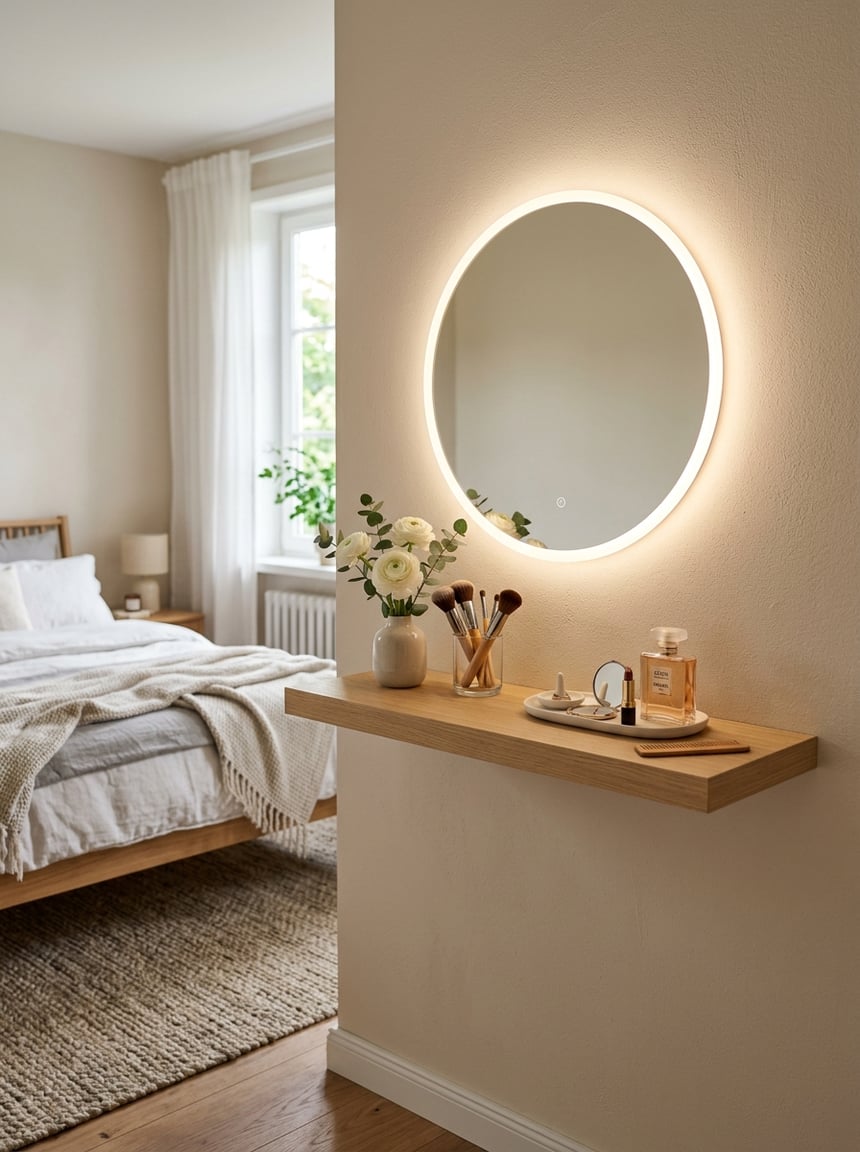
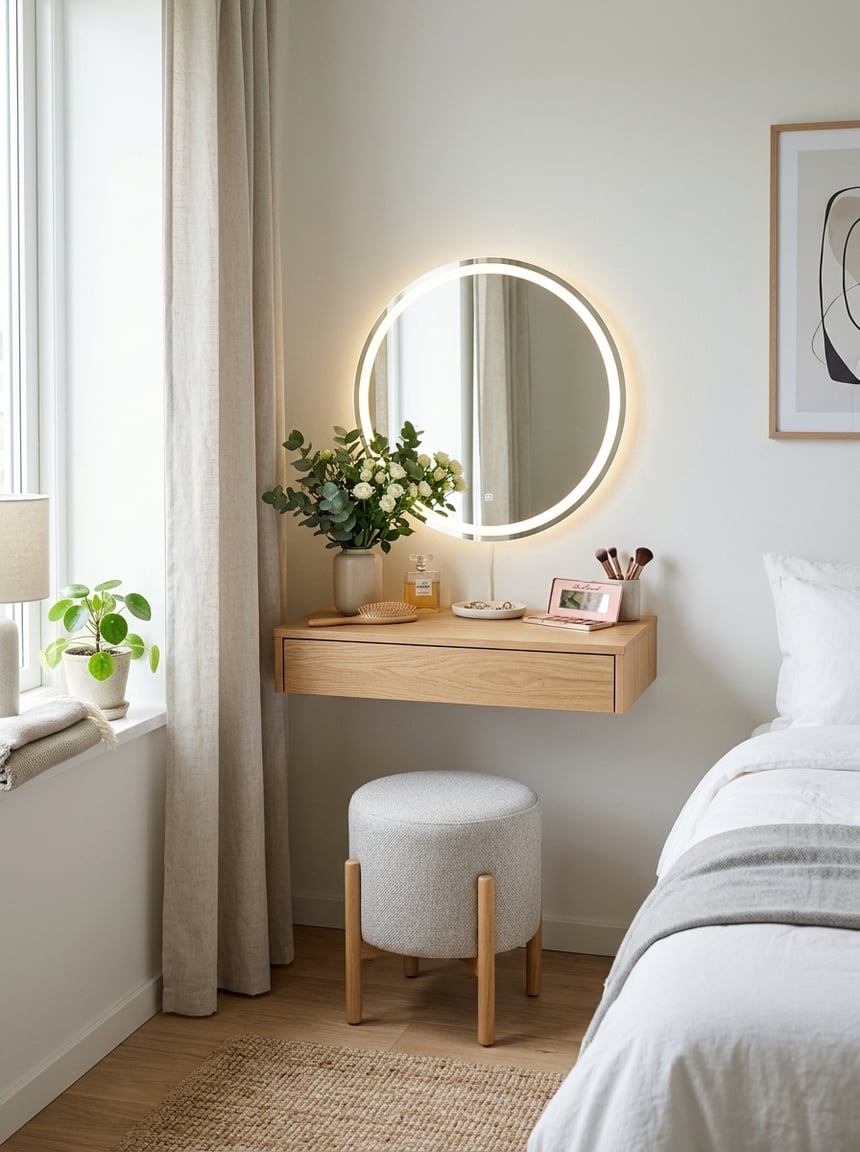
This is one of the cleanest small-room solutions because there is literally nothing on the floor. A shelf mounted at waist height with an LED mirror above it holds your makeup tray and a few daily items without eating into any of your walking space.
The LED mirror does double duty here: it adds a focused task light so you don't need a separate lamp, and the slim profile keeps the overall footprint tiny. Choose a shelf 10 to 12 inches deep so bottles and a brush cup fit comfortably without the shelf reading as a ledge you bump into. Anchor it into studs, and pick a mirror with adjustable brightness so it works for both early mornings and low-light evenings.
2) The Slim Console Table Setup
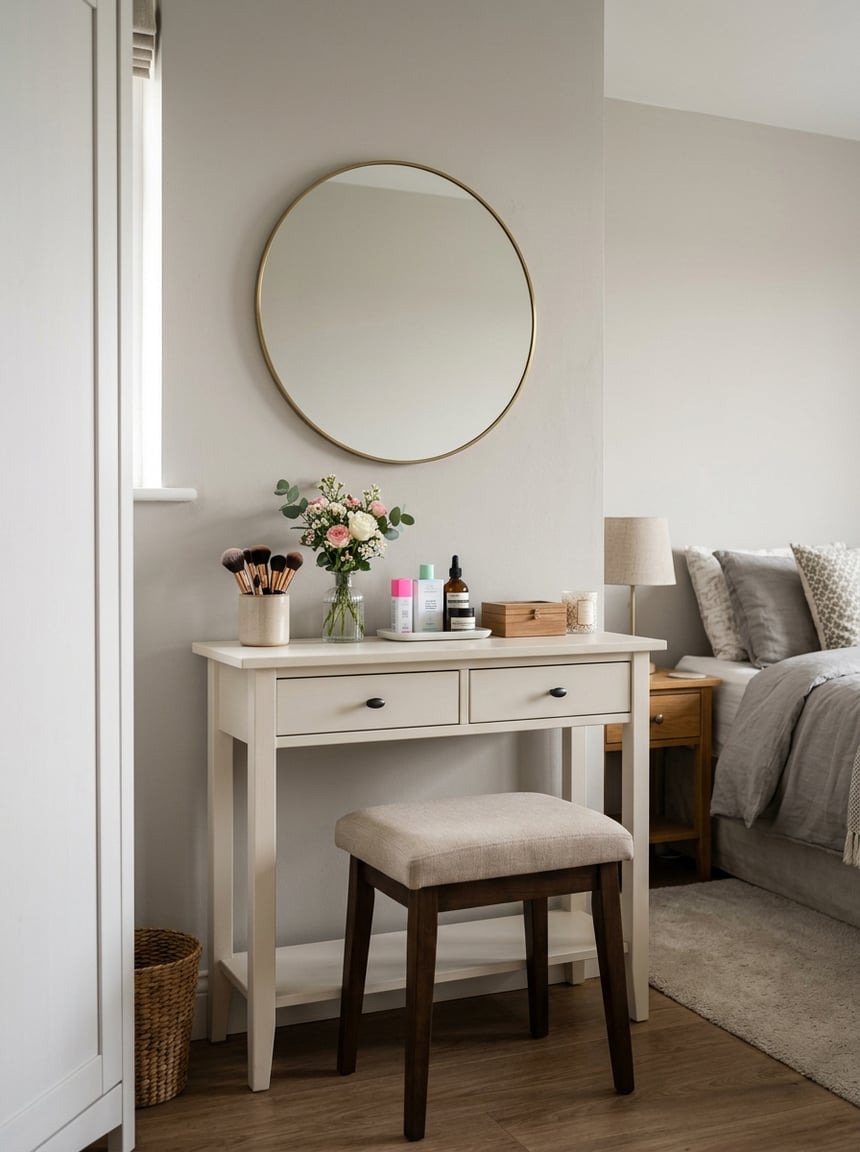
Tuck a narrow console against a wall, hang a round mirror above it, and pull up a small stool. The result reads like a dedicated vanity even though the table was never meant for that.
What makes it work in a tight space is the console's profile. Most run 12 to 14 inches deep, which keeps the pathway clear while still giving you a real surface for a mirror, a brush, and a tray of daily products. A console with a drawer or two hides the clutter that would otherwise stack up. A light finish - natural wood or white - keeps the spot from feeling heavy against the wall.
Aim for a width of 28 to 32 inches so it won't crowd a nearby bed or door. Mount your mirror at eye level, and use a thin pouf or flat stool that slides fully under the table when you're done.
3) Behind the Door: a Folding Makeup Station
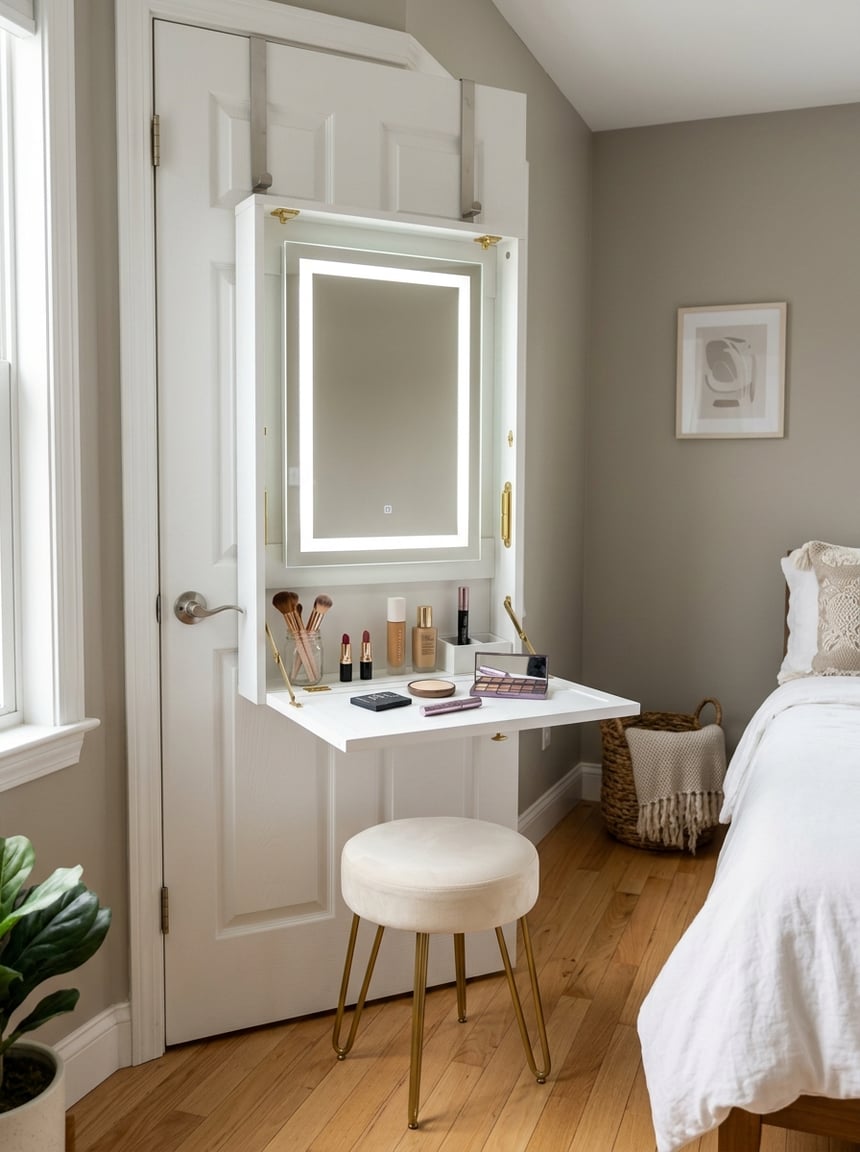
This one surprises people. A slim cabinet mounted on the back of a door folds down into a small tabletop with a mirror and a few shallow trays. Closed, it looks like a narrow decorative panel. Open, it gives you a tidy spot to sit and get ready without pulling anything into the room.
It works because it uses vertical space that already exists - the door - and keeps the footprint entirely at the wall. Light from a nearby window or a battery-powered mirror handles task lighting. Choose a unit no wider than 18 to 24 inches so it clears the trim and opens fully without hitting furniture. Add a few adhesive hooks inside the cabinet for necklaces, and line the tray with a low-profile felt pad to keep brushes from rolling.
4) A Vintage Sewing Table, Reassigned
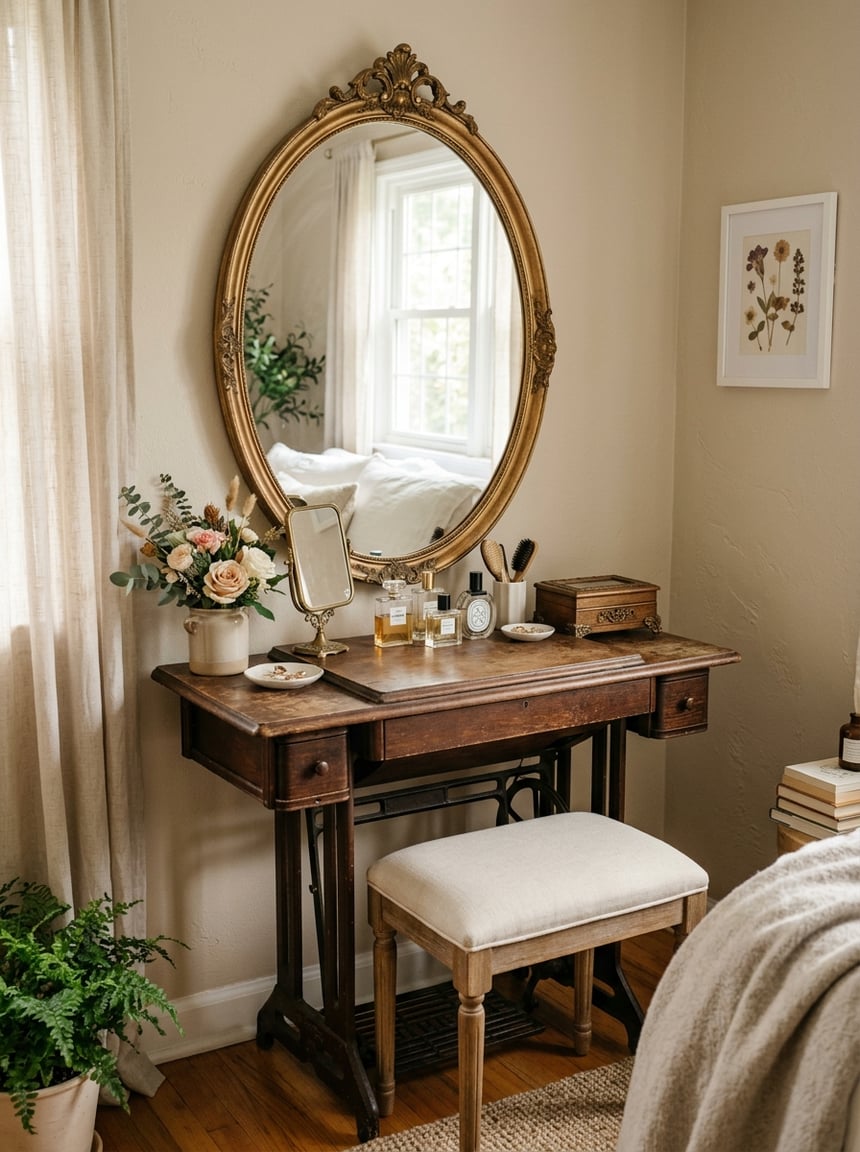
Thrift stores and estate sales are full of slim sewing tables that most people walk past. A 1950s or 1960s model with a fold-out leaf and a shallow drawer is almost perfectly proportioned for a vanity, and it already has the narrow footprint a small bedroom needs.
Push it against a wall, hang a round mirror above it, and add a small lamp on one side. The drawer holds brushes and palettes, so you don't need a separate organizer taking up surface space. Aim for a table around 24 to 30 inches wide, and use a low-profile stool that tucks under the leaf when you're finished getting ready.
"The best small-room vanity is one that looks like it was always supposed to be there."
5) Clip-On Mirror and a Tiered Tray on the Dresser
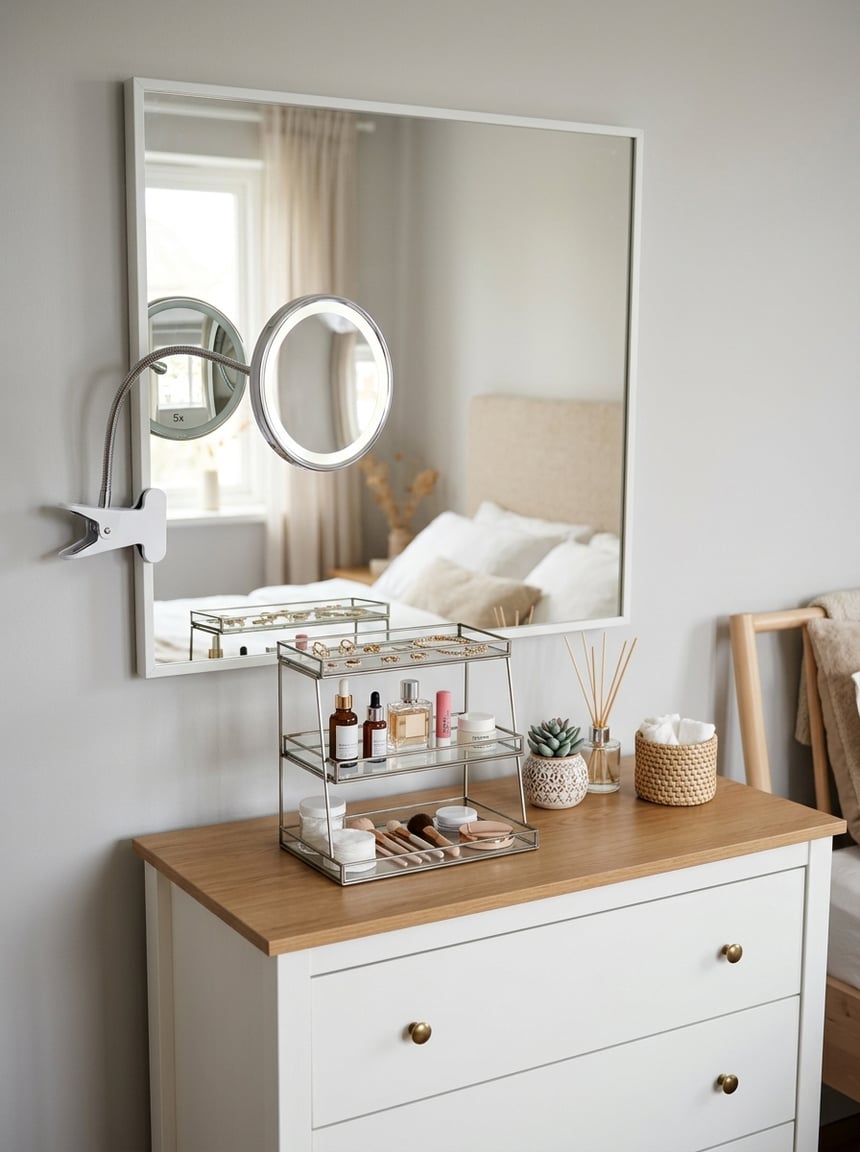
If your dresser already has a mirror, clip a small magnifying mirror to its frame or to the top edge of a nearby shelf. Add a narrow tiered tray beside it for bottles and brushes. That's it - you have a working vanity surface without buying anything significant.
The tiered tray is the key detail. It stacks items vertically so you're using the dresser surface more efficiently, not just piling things on it. The clip mirror folds away when you don't need it, so the dresser still functions as a dresser. Choose a clip mirror with a 3 to 5 inch diameter so it doesn't dominate the space, and a slim 2- or 3-tier tray around 8 to 10 inches wide to hold daily items without crowding the top.
6) A Medicine Cabinet Mirror Above the Chest of Drawers
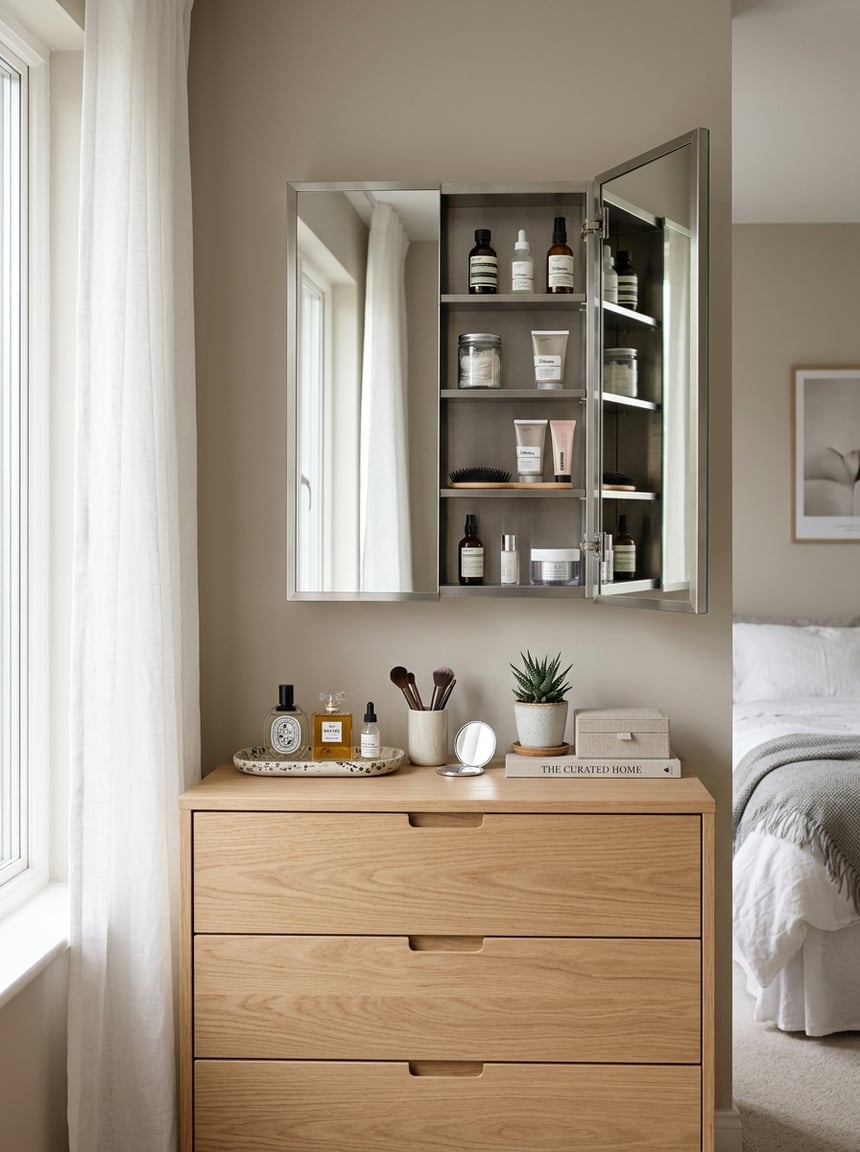
Hidden storage plus a mirror at eye level, without touching the floor space at all. Mounting a shallow medicine cabinet above a chest of drawers turns a basic dresser into a full grooming station. Open the door, and you have concealed shelves and a mirror; close it, and the room looks calm.
Choose a cabinet roughly the same width as the chest, or slightly narrower, so the two pieces read as one considered unit. Keep the depth to 3 or 4 inches so the drawers below still open cleanly. A small tray or glass cup on the dresser top handles whatever you want within immediate reach.
7) The Drop-Down Wall Desk as a Vanity
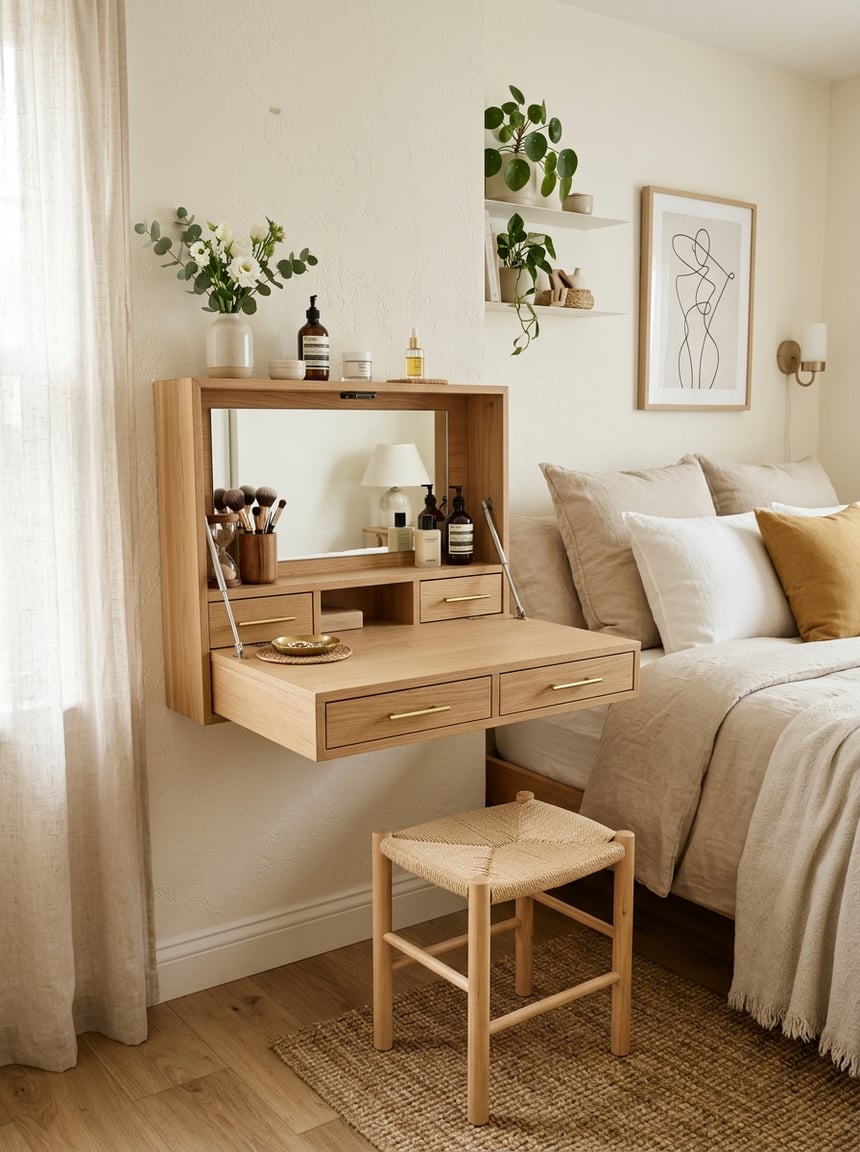
A fold-flat wall cabinet opens into a small work surface with a mirror propped inside the lid. Closed, it's a decorative wall panel with nearly no projection. Open, it's a proper vanity with a surface, a mirror, and hidden storage in the cubbies below.
This is particularly useful in rooms where the vanity truly only needs to exist in the morning. It frees floor space for the rest of the day and can double as a small desk or display shelf when you need it. Mount it at a height that suits your chair, choose a unit around 24 to 30 inches wide, and run a thin LED strip inside the cabinet for even light without a bulky lamp on the surface.
8) Dead Corner, Solved: the Triangular Shelf and Swivel Mirror
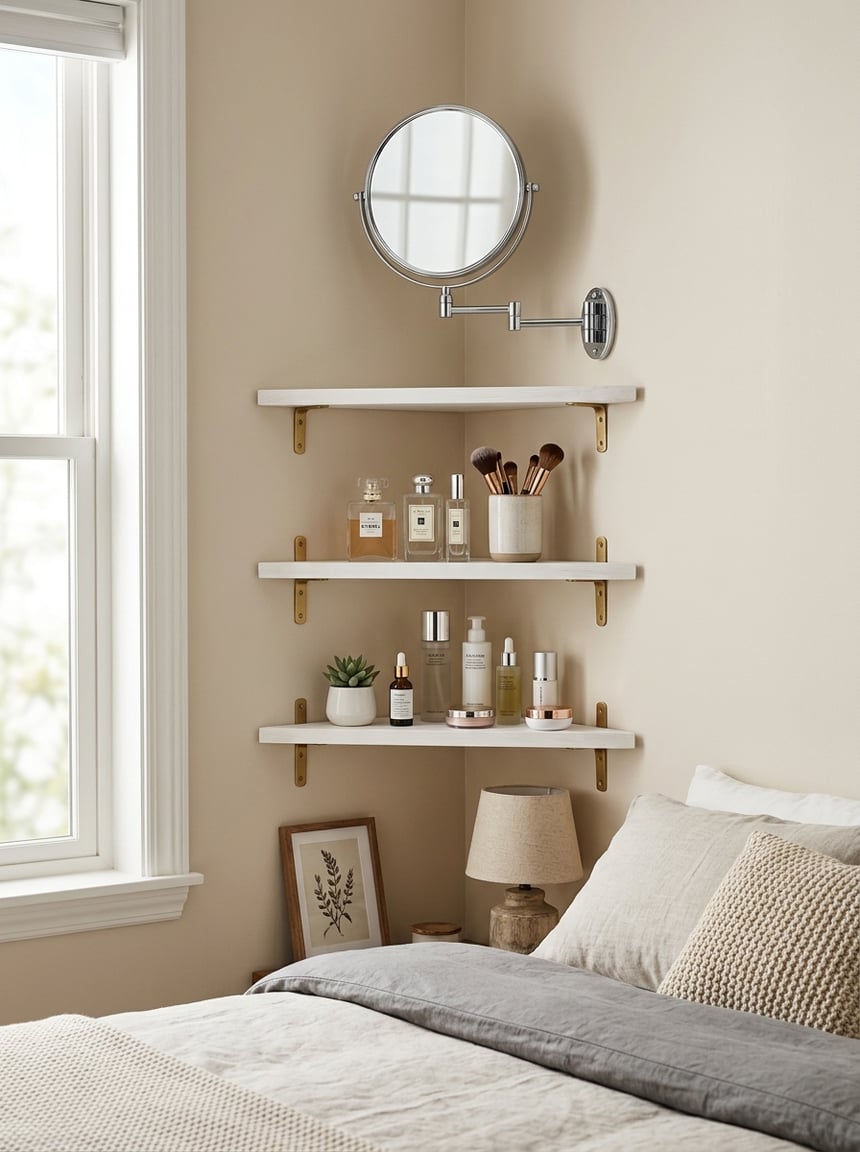
Corners are genuinely underused in most bedrooms. A slim triangular shelf fits snugly where two walls meet, and a round swivel mirror mounted on an articulating arm above it gives you a grooming surface without a tabletop.
The shelf holds your daily bits - a lip product, a brush, a small tray - without projecting into the room. The swivel arm folds flat against the wall when the corner is empty. Keep the shelf around 10 to 12 inches deep, and tuck a small basket underneath for extras so the top stays clear.
9) The Rolling Cart That Goes Where You Go
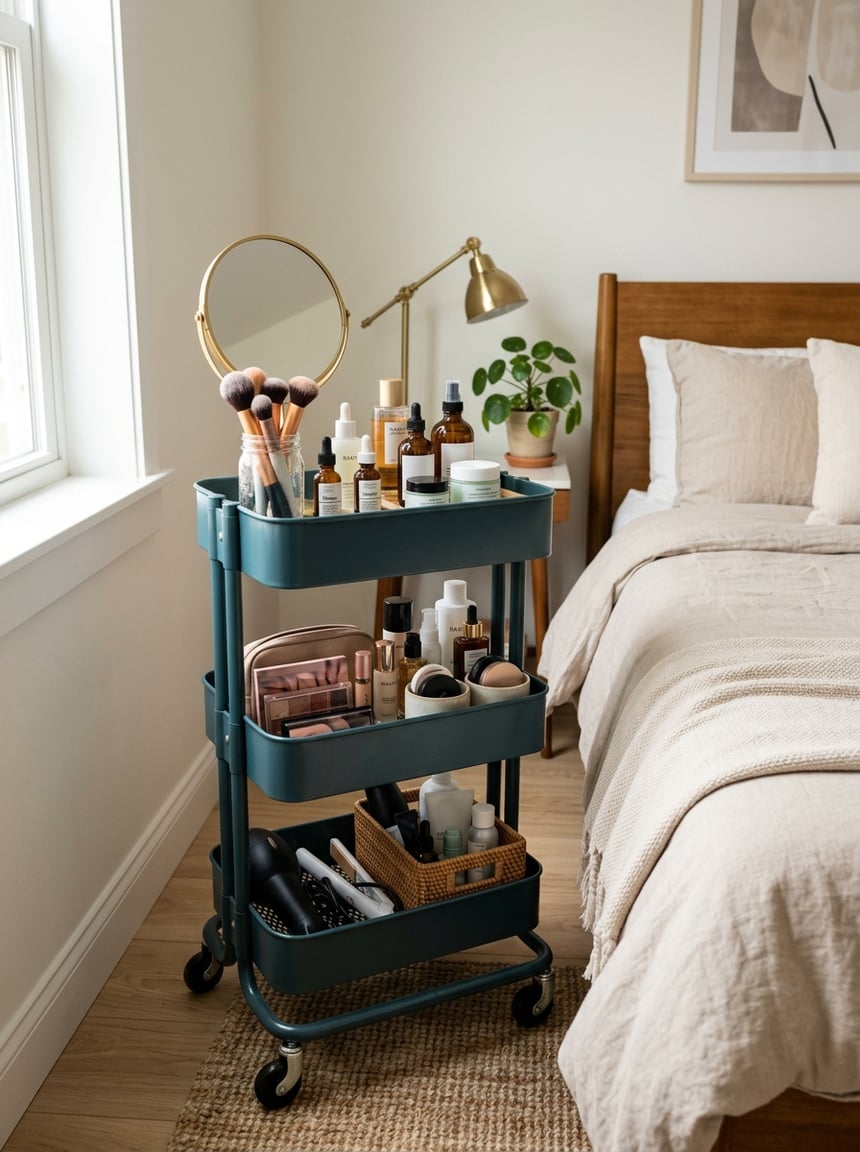
A slim metal cart - the kind originally sold for kitchen use - works surprisingly well as a mobile vanity. Clip a round mirror to the top shelf, add a small tray for brushes and a jar for makeup brushes, and you have a deliberate-looking setup that moves wherever the light is best.
The footprint is the appeal. At 13 to 16 inches wide, a standard cart fits tight nooks and slips through doorways. Wheel it near a window in the morning, park it in a closet at night. Use shallow baskets on the lower shelves so nothing slides around, and designate one shelf for daily items so you're not digging through the cart every morning.
10) A Magnetic Board That Keeps Everything Vertical
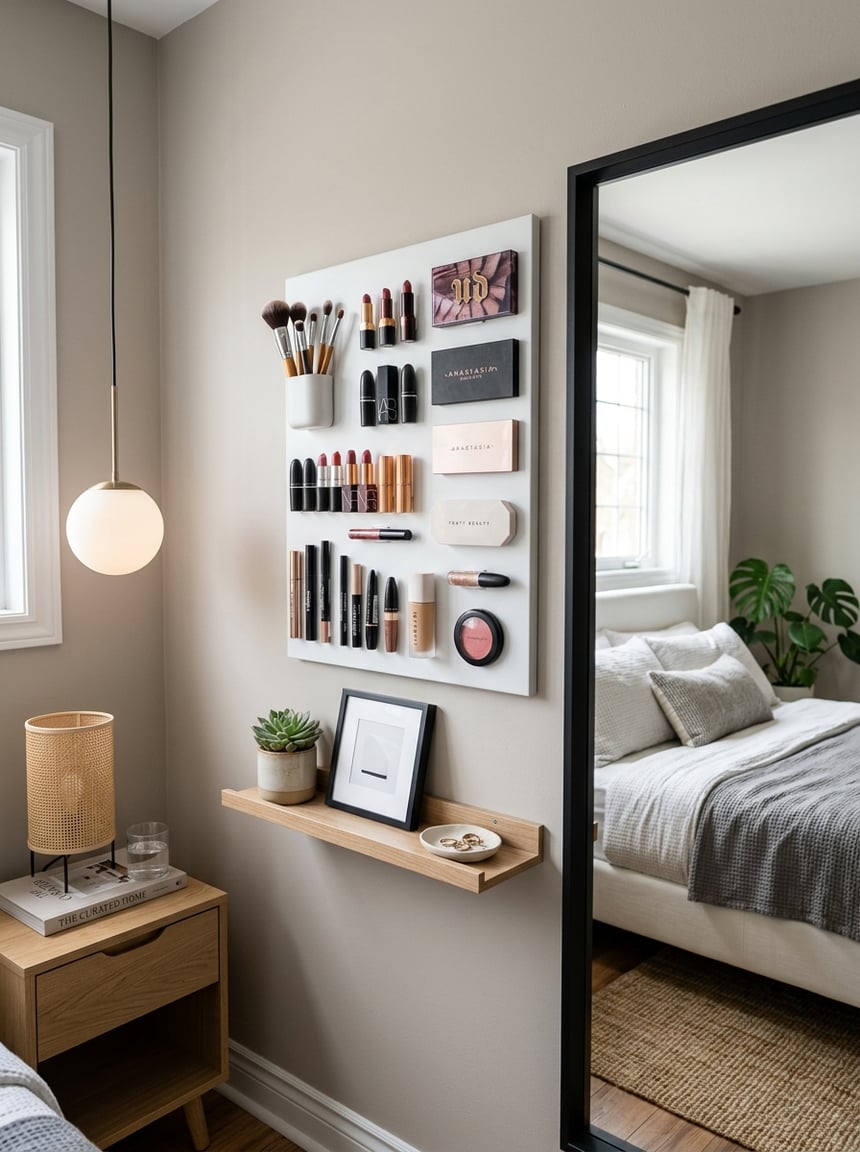
Paint a thin pegboard to match your trim and attach small metal tins and magnetic palettes in a neat grid. Mount it above a slim shelf or beside a mirror. Tools stay visible, easy to grab, and completely off every surface.
The board takes only a few inches of wall space while freeing up dresser tops and shelves for other things. Choose a board around 18 to 24 inches wide, use uniform tins for a tidy look, and mount it at eye level so you're not bending or reaching. It's one of those solutions that looks intentional rather than improvised, which matters in a room you want to feel calm.
11) A Bookshelf Cubby Styled as a Vanity Niche
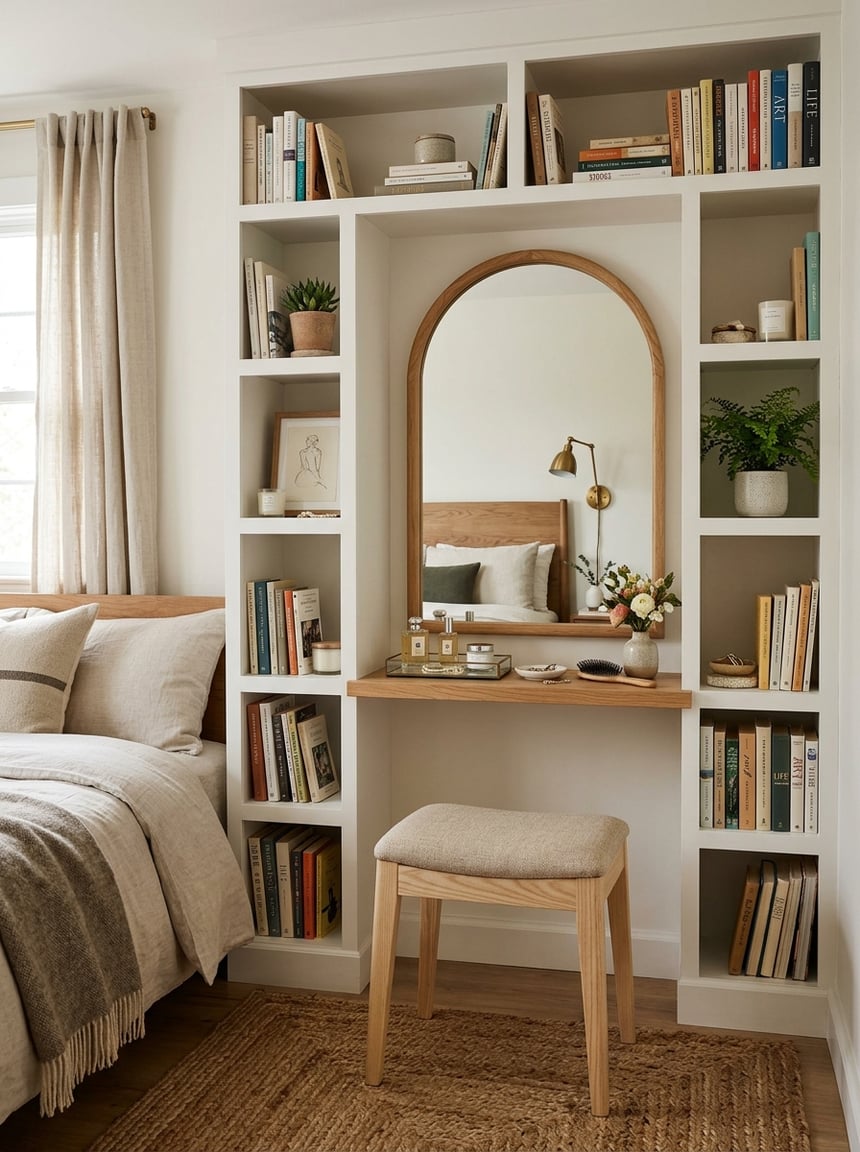
If you already have a bookshelf with an open cubby at the right height, you're most of the way there. Add a round mirror above the narrow shelf, slide a stool in front, and the cubby becomes a vanity niche without adding any new furniture to the room.
The shelf depth should be 10 to 12 inches - enough for toiletries and a brush cup without jutting into the room. Style with a small tray for brushes, a slim lamp if there's room, and a lower cubby with a basket for overflow. The stool slides under the shelf when you're done, so the floor stays clear.
12) The Window Ledge Setup
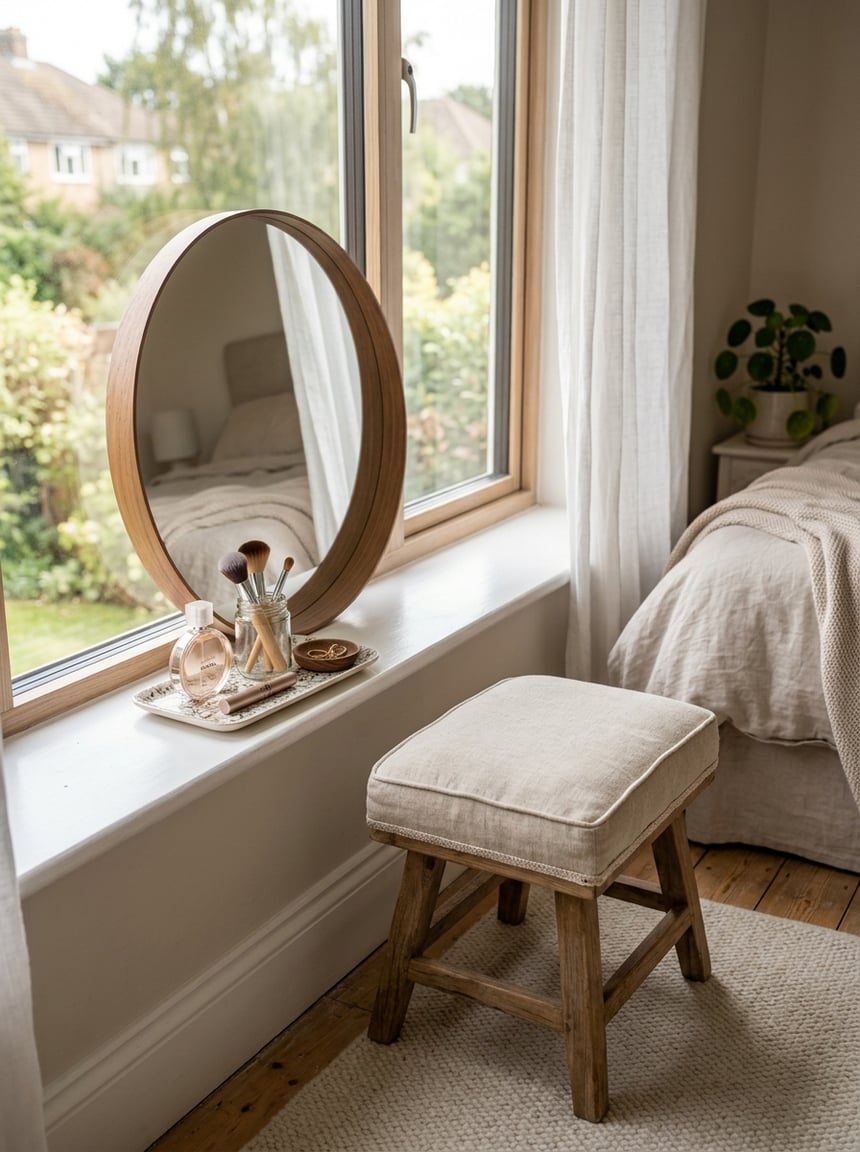
Natural light makes makeup colors truer than almost any artificial bulb. If your bedroom has a window ledge deep enough to hold a tray, that's already your vanity surface.
Prop a round mirror against the window frame, set a shallow tray beside it for brushes and a few products, and tuck a slim stool under the ledge. The light does what an LED mirror tries to replicate, and the footprint stays minimal because you're using a surface that was already there. Choose a mirror no wider than the ledge depth so it sits securely, and use a low tray with compartments so items don't shift when you open or close the window.
Style Tip
North-facing windows give the most consistent natural light throughout the day - useful if you're getting ready at different times. South-facing windows are brighter but can shift dramatically between morning and afternoon. If your window ledge vanity gets direct sun, a sheer curtain just behind the mirror softens the glare without losing the benefit of daylight.
13) Nightstand as Vanity: the Tray-Top Setup
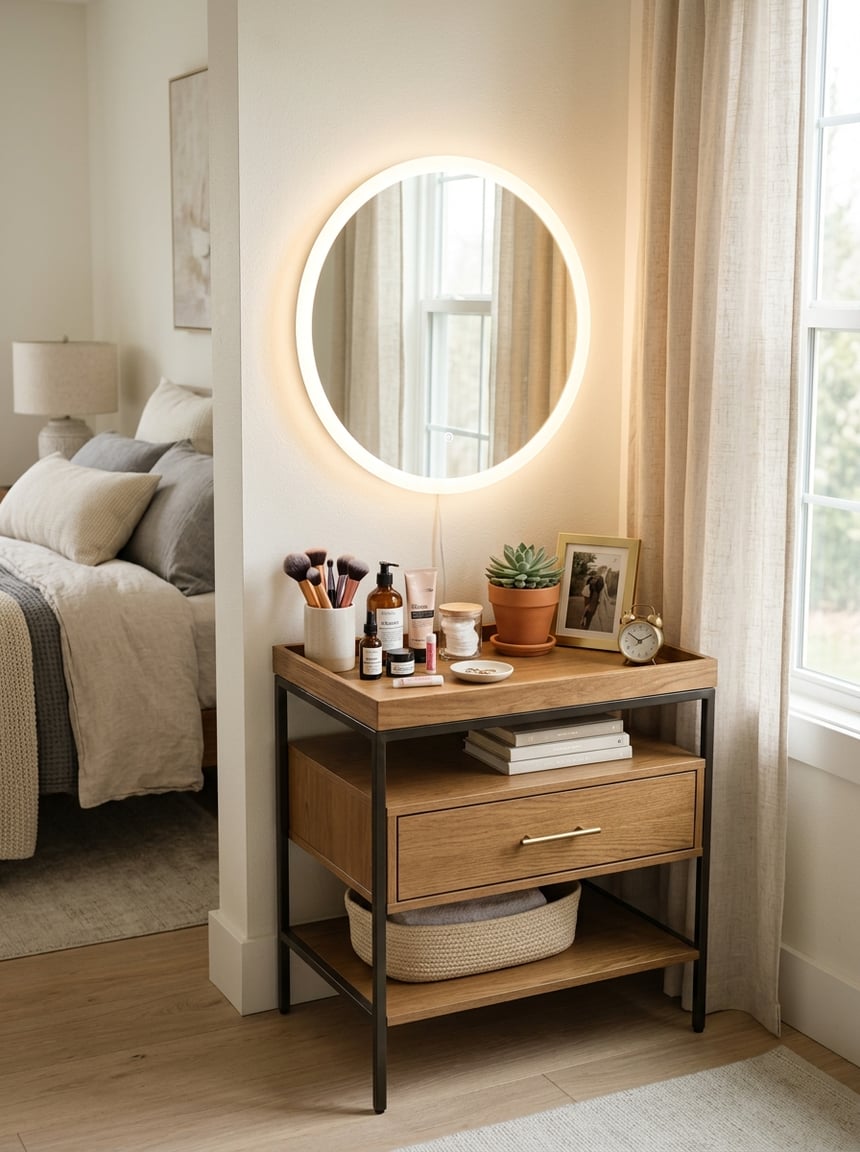
A shallow tray on a narrow nightstand, a slim organizer, a few brushes, and a small lighted mirror you can angle - that's a vanity station that lives inside your sleeping area without adding a single piece of new furniture.
The tray does the organizing work. Everything inside it stays corralled, and the whole thing can move if you need the nightstand surface for something else. The lighted mirror gives bright, focused light exactly where you need it, which matters when your ceiling fixture is behind you and casting shadows. Choose a tray around 12 to 16 inches wide so it doesn't overhang the edge, and pick a lighted mirror that clips or stands flat - one that doesn't require its own counter space to function.
14) Pegboard Wall With Mirror, Shelf, and Hooks
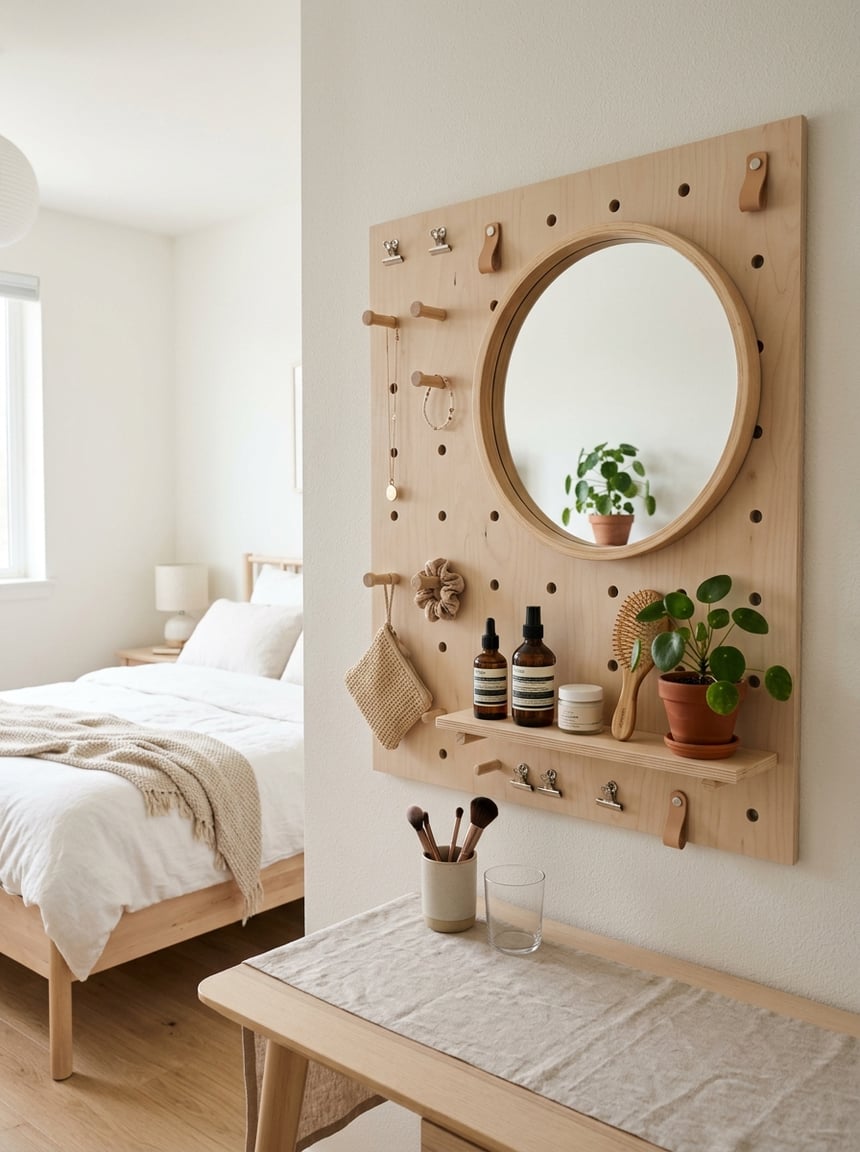
A pegboard painted to match the wall holds a round mirror, a narrow shelf, and rows of hooks for brushes and jewelry. It reads like a studio wall you walk up to, not a piece of furniture taking floor space.
The key to making it look intentional rather than cluttered is grouping by category and leaving some hooks empty. Mount the shelf at eye level and position the mirror offset so the hooks sit beside your reflection, not behind it. Choose a pegboard at least 24 to 36 inches wide so you can spread items out. Use small baskets on the shelf for powders, and a hook strip for hair tools with a cord clip nearby to keep cables from dragging.
When the Vanity Borrows From Other Furniture
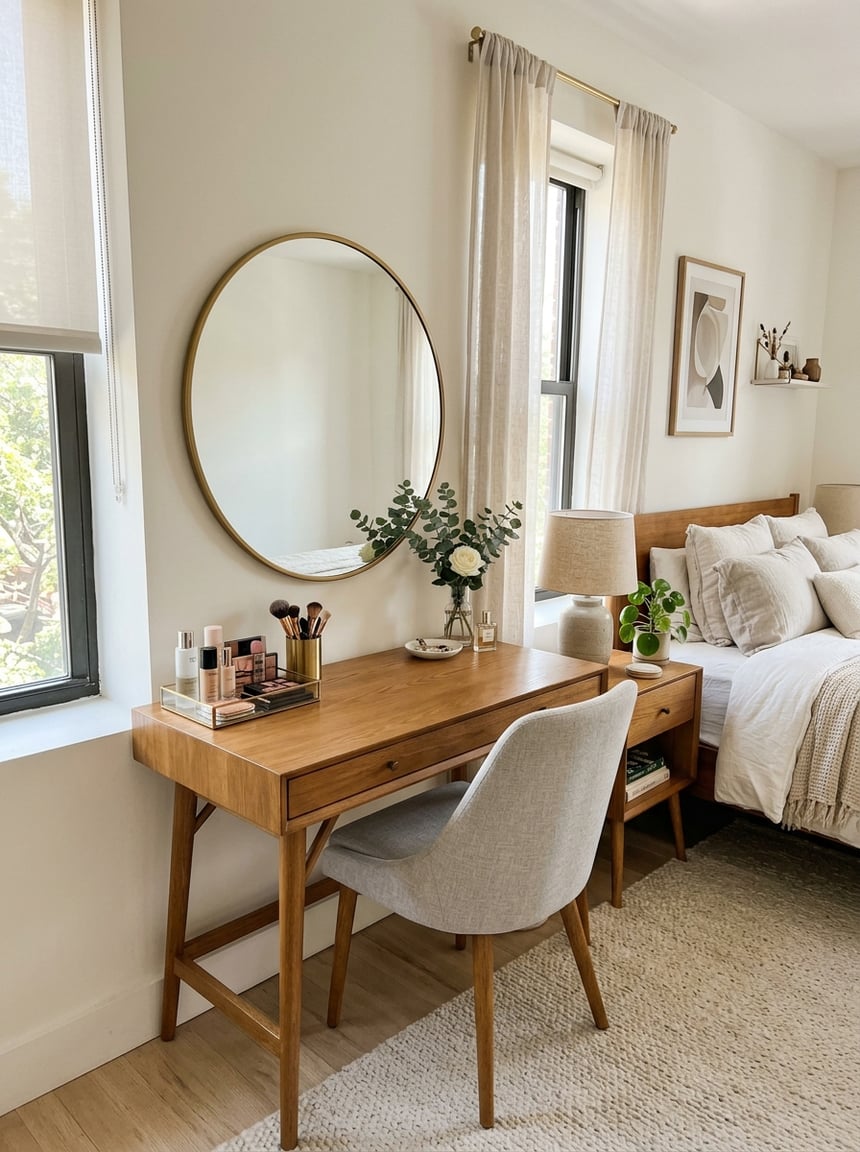
Most of the setups above fall into two categories: either you're adapting an existing piece of furniture to hold vanity functions, or you're using wall space instead of floor space. Both approaches keep the footprint small, and both work better when you think about them together.
Repurposing Console Tables
Place a slim console under a window or beside the bed. Use a stool that tucks fully underneath so the floor stays clear when you're not seated. Mount a round mirror slightly above the table surface so you can sit close without blocking your light.
A console with one shallow drawer handles brushes and chargers. A narrow tray on top groups daily items. An LED mirror keeps detailed work possible without a bright overhead fixture flooding the whole room. Most consoles run 12 to 16 inches deep, which keeps them out of any walking path.
Floating Shelves as Makeup Stations
Mount two or three floating shelves at seated height above a slim chair or stool. The lowest shelf sits at about 28 to 30 inches for a working surface; a smaller shelf above handles storage. Group clear jars or labeled boxes so products are visible and easy to find without pulling everything out.
Keep shelves 10 to 12 inches deep. Paint the back wall a shade lighter or darker than the rest of the room to define the zone - this small contrast makes the shelving read as a designated area rather than a random spot on the wall, which matters for how the room feels overall.
Lighting and Organizers That Don't Fight the Room
Getting the vanity spot to function well is one thing. Getting it to disappear into the room when you're not using it is another, and that's where lighting placement and organizer choices matter more than most people expect.
Lighting Placement for Task Zones
Mount a plug-in or hardwired LED sconce about 28 to 30 inches above your working surface. Position it beside the mirror so light hits your face evenly from the side - overhead ceiling lights cast downward shadows that make close work difficult. Use a bulb in the 2700 to 3000K range for warm color accuracy, at 800 to 1200 lumens for solid brightness without glare.
If you're using a frameless mirror, a thin LED strip along the sides creates even fill light with very little hardware. For detailed work, add a small daylight mirror with a clamp that attaches to a shelf or headboard. Hide cords with adhesive cord channels, and keep your switch within arm's reach so you're not crossing the room in the dark.
Organizers That Blend In
Shallow trays and narrow acrylic drawers on a dresser top or floating shelf keep daily items contained without looking like storage. Go for clear or white trays about 3 to 4 inches deep, and group similar items - brushes together, lip products together - into 3 or 4 small containers. The surface stays calm, and grabbing things is faster when categories are fixed.
For hair tools, a slim wall pocket or fabric organizer on the back of a door or the side of a wardrobe keeps them off every surface. Match it to the wall color so it reads as part of the room. Makeup bags that fit a dresser drawer's depth - around 6 to 8 inches - can stash out of sight entirely and still come out in one move.
Trend Alert: Magnetic and modular wall systems are replacing pegboards in a lot of small-room setups right now. The appeal is that individual components - shelves, hooks, mirror clips - can be repositioned without redrilling, which makes them genuinely useful in rental spaces or rooms that change function over time. Worth looking at if you want flexibility beyond a fixed layout.
The room doesn't need to announce that it has a vanity. It just needs one spot where getting ready is easy, the light is decent, and nothing has to be moved to make it work. That's the whole goal - a corner that does its job quietly.